When Cody and I drove home across the Los Angeles freeways with the yellow, orange sunset spreading across the sky I sensed in my heart that something shifted and changed our lives in a monumental way. I was happy and could tell by the twinkle in Cody’s eyes and the brightness in his face that he was happy too. We were excited about what we just experienced and happy to be heading home to pack our bags for a very different kind of adventure.
Early the following morning, sleepy eyed and pumped up with coffee, we boarded the Catalina Flyer with Andre, Paul and Tim who were Cody’s classmates, and two other parents then headed off to the shores of Catalina Island. The boat ride was icy crisp with the ocean air blowing wildly across our faces and through our hair. We made our way down to the lower decks to get away from the cold and took our seats for the 1 hour ride to the island.
As the boat reached the dock George and I couldn’t help but noticed that something felt different. The bright spring sunshine lit up the colors of our surroundings. The color of the sky was a vibrant blue that looked like it could go on forever. The smell of the ocean was crisp and clear and the air was much cleaner. It sparkled with a clear breezy crispness as it carried the warmth of the sun to gently touch our faces.
George, quickly made his way out to the cove in a half-run half-tiptoe fashion. He stopped at the shoreline and stood there quietly, intently peering through his sunglasses into the water. There were several silvery colored fish playing along the shoreline.
“The fish are friendlier here,” He said, smiling brightly.
I noticed a sweetness in the tone his voice that didn’t quite match his tall stature.
How could fish be friendly? How can you tell if fish are friendly? I wondered.
George was still standing at the shoreline looking down at the fish. His bright red baseball cap cast a shadow over his face, hiding his expression. His kaki knee-length shorts and casual Hawaiian shirt were not his usual attire. Most of the time when we saw George he was dressed in slacks and a dress shirt.
“Look! They just swim up to my feet. They don’t act like they’re afraid at all,” he commented as if to answer my question.
As my mind began to ponder, a woman walked up and introduced herself.
“Hi, Are you Karen? I’m Ellen Kelly. Welcome to the Wrigley Marine Science Center.”
Ellen ‘s handshake was warm and gentle. Her eyes were hidden behind a large pair of blue-gray shaded sunglasses. She wore a kaki colored sunhat that looked like a cross between a bucket hat and a fisherman’s cap pulled over her blond shoulder-length hair. When she smiled her whole face lit up in an expression that made me feel like she was happy to see us.
“The fish seem friendly here,” George said.
“That may be because they know they’re not hunted. This is a natural preserve. This cove is a protected environment. No fishermen are allowed here. We are here to do research, and people come from all over the world to do research here at the institute.”
How do the fish know if they are being hunted? I wondered. How do fish know?
A shiny black raven called out in a loud cawing sound and flew passed our heads as Ellen led us our dorm rooms.
“Don’t leave your bags outside,” Ellen warned us. “The raven’s will unzip them and take out your belongings. We have a comical but sad story about the ravens unzipping people’s bags. One day an elderly woman left her bag out on the lawn. A raven unzipped it and threw out all her belongings all over the yard. It was kind of embarrassing. There were diapers all over the lawn. I felt so sorry for her.”
“Are you saying that th e ravens knew how to open our bags? Wow, that’s really smart,” I said.
“Yes, and somehow they teach the other ravens their tricks. Now all the ravens know how to open the bags,” Ellen explained shaking her head.
“That’s so fascinating. It’s like these animals have some kind of innate intelligence.”
“Are you ready for first lesson?” Announced Ellen as young woman walked up.
“I’d like you to meet Terri.” Said Ellen. “ Terri is new to our staff. She’s been with us for about 3 weeks now.”
Terri greeted us with a smile
“Hi guys,” she said glancing at the circle of boys and their 3 parents.
“I’m going to take you to visit the touch tanks.”
“What are touch tanks?” Tim asked thoughtfully.
“When we find sea creatures and fish in the tide pools and in the ocean that we want to study we bring them to the touch tanks. The touch tanks are a temporary home for the creatures while we get a chance to study them.”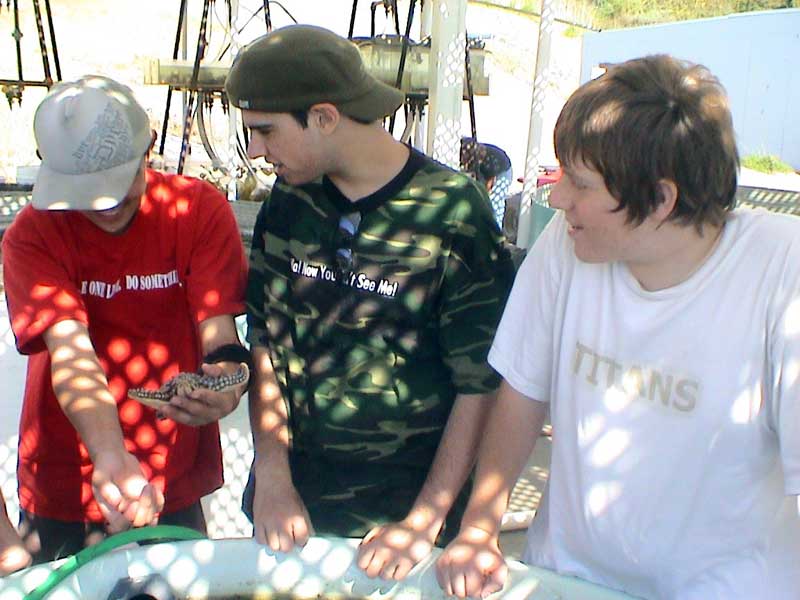
The touch tanks were large glass enclosures that stood just above waist height. The low sides allowed us to get a closer look at the variety of fish, crabs and the other creatures that lined the floors of the tank.
The tanks were housed in a patio-like structure with a slatted roof to provide shade.
The boys placed themselves around the sides of the tank and peered intently into the water to see what they might find.
“You can touch them if you like,” Terri explained, brushing her shoulder length hair from her eyes. “That’s why we call these touch tanks. When we find new specimens we bring there here for observation.”
“What’s that?” Andre asked.
Cody, Tim and Paul were standing on either side of Andre. They were all looking at the oddly shaped brown spotted creature beneath Andre’s pointing finger. The animal looked like a cross between a blowfish and a rabbit with two sets of ears.
“Oh, this is what we call a sea hare” Terri answered.
Terri gently placed her hand beneath the sea hare and placed it into the palm of her hand.
“Here, you can hold it.” She said and placed the sea hare into Andre’s hesitant hand.
“Look you can see it’s face.” Terry continued to explain, “Here are the eyes and this is the mouth.”
“Oh it’s soft.” Andre commented.
“The sea hare’s have two sets of tentacles. The larger tentacles on the top of it’s head almost look like rabbit ears. That’s why we call it a sea hare.”
“It’s so squishy. Here do you want to hold it?” Andre said and placed the white and brown blob into Paul’s hand.
Zoe was standing next to Paul with his camera focused on the sea hare. “Let me take a picture.” He announced.
“It is soft and squishy.” Paul commented and placed his hand with the sea hare back into the water. The sea hare came back to life as the two finger like tentacles on the top front of it’s head perked up like rabbit ears.
“That’s why they call it a sea hare.” Said Andre, “He does sort of look like a hare or a rabbit.”
Terri picked out a creamy colored sea star. The creamy white color of the star was accented with splashes of bright orange. The sea star seemed to change form too as she lifted it out of the water.
“Look this sea star has a face too. Well, sort of. It does have a mouth. Here are it’s tentacles. It has hundreds of tiny tentacles that help it move.” Terri explained pointing to the hundreds of small tentacles on the underside of the star.
The boys gathered around Terri to see what she was describing.
“See this little opening?” Terri said as she turned the sea star onto it’s back. She was pointing to the center of the star’s underside. “This is what we would call it’s mouth.”
Terri then picked up a conch shell that had what looked like a set of claws and tiny legs protruding from the opening.

Terri picket up the little hermit crabs to show us it’s face.
“This is a hermit crab. We call them hermit crabs because they live in shells of creatures that have already died. When they grow they just find another shell and move in.”
Terri explained. “There are several of them in the tank here.”
The boys each picked up a tiny hermit crab. There was a wide assortment of little crabs ranging in size from just a fraction to one inch wide and even some that were a larger. The crabs also had a wide variety of shells that housed them.
The cheerful laughs and chuckles of the boys and their dads filled the air as the little creatures scampered wildly across the tank in their attempts to avoid getting caught.
“These have faces too. It’s mouth is hidden under the shell and these are it’s eyes.”
Terri held up a little crab to demonstrate.
“Wow, these little creatures have faces?” commented George.
“If you pick up this snail and look underneath it has a face too.” Terry said pointing out the tentacles and mouth.
“I never thought of them as having faces.” George said as he examined the face of the snail.
Terri then announced. “You have a few minutes before your next lesson. You are welcome to examine any of the fauna here in the touch tanks.”
Andre picked up the sea hare and pulled it up out of the water.
“He looks so sad when I pull him out of the water.” Andre sighed.
“Yea, he looks like he’s melted.” Commented Cody.
Andre put the sea hare back under water. The sea hare perked up the moment he entered the water and swam away.
Somehow seeing the faces of the sea animals seemed to change the way we felt about them. These were living creatures too, living like me.
I watched the little hermit crab scamper across my hand as I placed it back into the water. The tiny claw moved back and forth between the water and it’s mouth as if it was feeding on invisible food particles.
“Are you ready boys?” Terry announced cheerfully. “We’re going back to the cafeteria and then Ellen will lead you on a short nature walk.”
During our short hike across the nicely paved grounds of the Wrigley Science Center as we walked to our next lesson, I couldn’t help but ponder about what we had just learned.
Then I remembered.
A memory began to surface of the only field trip that Mr. Stouffer took us on, in High School Biology class. Mr. Stouffer had taken the entire class of High School Biology students to visit the tide pools at Laguna Beach. I remember falling in love with the hermit crabs and how the tiny creatures had changed the way I looked at all living creatures. Each little tide pool on the rocks of Laguna Beach formed a temporary ecosystem within itself. They were like little words within a bigger world. Each tide pool contained a different set of creatures that would share their little world for 12 hours before the tides changed and washed their little world away. I remember seeing the living intelligence in the animals back in High School. So many years had passed between then and now, I had forgotten.
The memory faded as we stepped through the doorway of the cafeteria.
Ellen greeted us cheerfully, then began a short history lesson. “Years ago, Catalina was a well preserved ecosystem. We used to have trees here. The whole island began to change when the settlers came from Spain and other countries. She had to learn how to adapt to the changes brought to her shores and onto her land by the surrounding ocean and by man.”
We followed Ellen across a small trail lined with plants and bushes. Ellen stopped and pointed to the shore. On the shore was a scattering of what looked like giant toothpicks that someone spilled on the shore and never bothered to pick them up.
“These are giant reeds that were washed up to the shoreline. They were introduced to America by the early Spanish Military. These reeds were used by the Spaniards to line walls. The giant reeds became an environmental problem both for the mainland and for the island when they began to block the natural water ways.” Ellen explained. As I listened to her speak it was obvious that she had a natural passion for nature and life and was concerned about the well being not only of the Island of Catalina but for all life.
“After 1996 with the heavy storms of El Nino the giant reeds were washed to the shoreline of Catalina. They soon took root on the island and became an evasive intruder.” Ellen stated.
The idea of a plant being an intruder had never occurred to me and yet here was an extreme example. It was interesting the way Ellen used behavior characteristics that we would normally associate with people.
“We’re going to learn about the plants of Catalina.” Ellen said as she lead us back to the hiking trail. “Plants are my specialty.”
Ellen explained as she walked and led us up a hill.
“Plants have to learn to survive just like animals do. They have to learn to adapt to environmental changes.”
The idea of plants learning had never crossed my mind.
“People from all over the world invaded the island and brought their plants and animals with them. The Spaniards brought wild oat.” Ellen pointed out a wild oat plant. She kneeled down slightly and picked off a twig to show us the dry-brown husks and pointed to the tiny oat kernel.
 “These seeds lie on the ground and when it rains they grow. Wild oak is an annual. It’s an adaption. They die and come up again every season. This is where oatmeal comes from.” Ellen peeled off the husk from the kernel, popped it into her mouth and offered a second twig to the boys. “Wanna try some?”
“This part of the oak is called an awn,” Ellen said pointing to one end of the kernel which had a dry sharp prickly prong.
“It does have a function. It gets stuck to animals and drops off somewhere. Annuals were designed to disperse the seeds.” Ellen continued.
Listening to Ellen it became very obvious that it wasn’t only the fish at the shore line who “felt” safe or the crows and ravens who learned how to unzip suitcases that had an innate intelligence. These plants did too.
As we continued to follow Ellen just looking up at the crisp blue sky was refreshing. The earthy colored hills that were covered with a patchwork of various colors of plant life and the ocean in the background were awakening to the senses. I could see why Ellen and her associates had fallen in love with the island.
From the corner of my eye I noticed that the boys were still plucking little grains of wild oat seeds. They were peeling off the husks and munching on wild oats just as Ellen had taught them.
Ellen spoke about many of the environmental intrusions that were brought to the island by man. Catalina’s original animals were the native fox, quail, ground squirrels, shrew, mice and various kinds of snakes. In the past 200 years people from other countries brought their goats, wild boar, barberry sheep, pigs, bison and ferrel cats.
There were many species of plants introduced to the island too. From Spain came the Black Mustard. She showed us how we could taste the little yellow flowers. Each of us picked off a tiny flower and plopped them into our mouths.
It was quite amusing watching the expressions on the boys faces as the corner’s of their mouths would turn up or down and their noses would crinkle.
There was Rip Gut Grass that often gets stuck in our socks back on the mainland was here in Catalina too. It was brought to the island by the Mediterranean explorers.
The familiar ice plants that can be seen lining the sides of the California freeways were also here in Catalina. According to Ellen the ice plants originally came from South Africa and were designed to withstand the hot climate. Their thick heavy leaves were built to absorb salt from the air.
“Australian Salt Bush came from Australia.” Ellen said. “These salt plants and others added salt into the soil which changed the environment for the original plants of the island. Some of the original plants could no longer survive in the salty soil and they just died off.”
The plants had much to teach us about the many ways they learned to adapt to the summer heat, the weather and to the changes brought to Catalina by the new species of plants and animals introduced by man.
The living intelligence within these plants either adapted or died. There was one particular species of plant that just moved to higher ground.
Ellen also gave us a short lesson on the evolution of Catalina. Many of the shrubs that she showed us were once trees. For thousands of years there were no animals to eat them so they just kept growing. Because they were not threatened by animals that might eat them they lost their nasty taste and their spines.
“It takes a large amount of energy to make a nasty taste.” She pointed out. “They didn’t need any protection so they used their energy to grow into trees.”
Cody, Paul, Andre. Tim, their fathers and I were standing in a circle around Ellen as she spoke.
“When the goats came they ate all the seedlings and we went from trees to grassland.”
As we stood there listening Ellen’s voice lowered just a bit, “Now the trees are gone. There are only skeleton forests left.”
The cactus spread across the land and Catalina became a desert.”
Ellen paused for a moment. Even the boys were silent.
“Just a few trees remained. If you notice the trees they have rings of cactus surrounding them. We call these Cacti Rings. The cacti protect the trees from being eaten.”
We paused for a moment as Ellen showed us the grey green flowery looking lichen that were growing on a wall of rocks. “These lichen are a combination of algae and fungus. The fungus and algae live together and a sort of relationship. The fungus protects the algae and the algae produces food.”
The idea of algae and fungi living together in a relationship changed the way we saw the odd looking formations on the rocks.
Ellen lead us up to a hill top and pointed out to the distant hills. “We used to have goats living up in the hills. The goats and the pigs and the deer ate everything. We had to take them off of the island. In 1990 we started to take out the goats. It took us 12 years.”
“How did you get rid of the goats?” asked George.
“The goats were bedded on the ridge tops. We had to take sharpshooters up in helicopters. The goats were there by the thousands. The pigs were taken out later.
Then the raven population increased. Big black banners of ravens came in after the helicopters. The ravens became a nuisance. Ravens know how to unzip luggage bags. They taught each other how to open our luggage bags.”
Still following Ellen on the trail we could see the cafeteria in the distance. I could tell the boys were getting hungry.
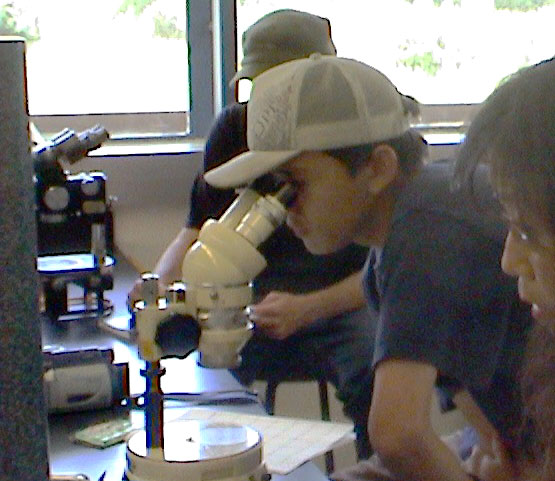 Ellen led us back to the plankton lab where we would be introduced to yet another world.
The plankton lab was a classroom filled with microscopes, slides and a smaller version of the touch tanks that we had seen earlier. The tank was filled with sea water, a few live sea urchins and a variety of other creatures.
“This is the plankton lab. What we will do here is learn about the microscopic life forms called plankton.” Ellen stated and handed out a booklet filled with hand drawn illustrations of plankton.
“Take a drop of water from the tank and put it onto a slide.” She instructed. “Then what we want to do is to see if you can identify what you are looking at.”
The boys each took a slide and followed her instructions.
Ellen demonstrated and placed a slide under the microscope.
“Oh look. There’s a copepod.” She explained and motioned to the boys to see.
“Wow! That’s really cool!” Tim exclaimed excitedly.
“This one looks like a space ship!”
“Oh yea, I can see little propeller thingys on this one. That’s so cool!”
The voices of the boys cheered with excitement. Even the parents were intrigued by what we were seeing under the microscope. When I glanced around the room everyone was smiling as they peered deep into the lens of the microscope.
“You have about 30 minutes.” Ellen stated. “There is another study group that will be using the lab. Find as many plankton as you can. I will come back for you in 30 minutes,” she continued and walked out the door.
Under the microscope we could see the tiny world of living creatures swimming, squirting and moving throughout the environment provided by a single drop of water.
As we observed the microscopic animals they revealed a world that we normally would never see. Many of the creatures were transparent and almost ghostlike. We could see the outlines of their outer membranes and a their inner structures pumping or vibrating while propelling their way through the water.
By the time Ellen came back the boys weren’t ready to leave.
“Can’t we stay a little longer? We’re not finished yet.”
“Someone else has this room reserved for now. You are welcome to come back later if you like.” Ellen explained.
I had never seen a group of young high school boys so excited about science. It was as if the tiny world revealed by the plankton captured their attention, almost as much as their hand-held world of video games.
That evening, as the sunset cast a brilliant orange red painting against the deep blue sky a rainbow of colors reflected off the ocean. We watched the sunset and were awed by the beauty of nature. It was not just the land or the sea that captured our attention. There was something so pure and innocent about the essence of the island.
As I lay in my bunk later that night, I couldn’t help but wonder about all the things we learned that day. There was an emptiness in my heart as I thought about what had happened to the little island of Catalina and how it was forced to change because of intruders brought by people. People like me.
I thought about the lessons that the plants had taught us in their own quiet way. As I pondered the quiet and peaceful beauty of the island I finally drifted off to sleep.
Early the next morning I was awakened by the realization that these life forms had a message to share with us.
My mind began to wonder then whispered, “Its a parable. Tell them about parables.”
The limbs of my body were still heavy with sleep. I looked up at the luminescent red digital numbers on the clock beside the bed, that clearly read 4:30 a.m. The space in the room was softly illuminated with an airy soft glow of natural lighting. It was too early even on a morning in May for the sun to be rising.
“Tell the boys about how God talks in parables,” The seemingly anonymous voice whispered again.
It wasn’t really a voice or a whisper. At least not an audible one. It was more like an idea or knowing in my mind and heart.
What parables? I wondered.
“Don’t you remember reading about the parables just the other day? You are the only parent here who remembered to bring a Bible. Look it up”
The boys were given an assignment to chose one life form from the island. They were to research their chosen species and find out all they could.
They were also all students at a Christian High School. The idea of parables seemed like it would give an added depth and meaning into their lesson.
I rummaged through my suitcase in search for my Bible and then remembered. There wasn’t enough room in my suitcase to comfortably fit a Bible. I packed it in Cody’s suitcase.
In my failed attempts to fall back to sleep my mind kept reviewing all that we had seen the day before. The island had a natural beauty. I could sense an innate intelligence within all her creatures. It was as if the fascination that had awakened way back in High school biology class had awakened again. I remembered the excitement that stirred from within the first time I looked through a microscope at the tiniest particles of life. The same kinds of questions that prompted my mind back then were wondering again. How can these creatures know when to move? How can the ravens teach each other?
Glancing at the clock it was now 6:30 a.m., early enough to call Cody.
“Huh?” answered Cody’s voice with a sound that was half awake.
“Yea, I have your Bible. Yea I’ll bring it to breakfast.” I could hear the sleepy annoyance in his voice.
“Can I go back to sleep now?”
After a breakfast of scrambled eggs, sausage, fruit and muffins I gathered our small group of boys at the picnic table on the patio deck.
“Andre, can you find the story about how Jesus talks to his disciples in parables?”
“Huh? What?” He answered in a tone that sounded half asleep.
Looking at his uncombed tousled hairstyle and the wrinkled attire that consisted of a pair of navy blue sweatpants with one of the pant legs half up his calf it was obvious that he was not an early riser. The other boys were not much different.
“You were all given an assignment to study one specific animal or plant of Catalina right?” I asked them.
“Or fish,” Tim added. His shoulder length red hair reminded me of the styles that were popular during my own teenage years.
“Did you pick one?” I wondered aloud.
“Yea, octopus,” answered Cody.”
“Shark” answered Tim.
Paul was standing there quietly with his attention focused intently on the small square preview screen of Zoe’s camera.
“Sea otter.” he responded.
“Sea hare” said Andre.
“What if each of those creatures has a meaningful story just for you? Maybe if you look you will find it.” I could tell by the looks on their faces as they sat with the dull early morning look in their eyes, these boys were not really paying attention.
We had quite a day ahead of us, with a one-and-a-half mile hike across the island, a visit to the mudflats, a trip out on the ocean to look at the sea bass breeding pens, and a boat ride
With all the excitement and the variety of lessons for the day why should they care about parables?
For the following three days, we listened to our teachers describe the land and the many species of plants and animals that lived there. We learned about the history of the island of Catalina and a much greater story began to unfold.
We saw moving creatures of the water,and winged creatures of the air. We touched many moving creatures, and witnessed creeping things. We learned about the herb bearing seeds. We examined and tasted many leaves, fruits and seeds. Some of them were native to Catalina. Some were endemic-found only in Catalina and its specific environmental conditions.
We listened and learned about the plants and animals that were brought to Catalina by man. Somehow the island and it’s environment began to change. The living intelligence and innate knowing within the plants and animals began to adapt to new conditions. Foreign plants and animals adapted to the environment Native plants and animals were forced to adapt to the changes brought forth by foreign conditions.
Some of them survived. Some of them died.
On the last evening of our stay, George, Zoe and I sat out on the patio and watched the sunset on the beautiful Catalina Island. From the picnic benches where we were sitting, the sky looked like a rainbow of pink orange and yellow splashed against the heavens. We quietly watched the rays of light changing the colors as the sun set down on the ocean.
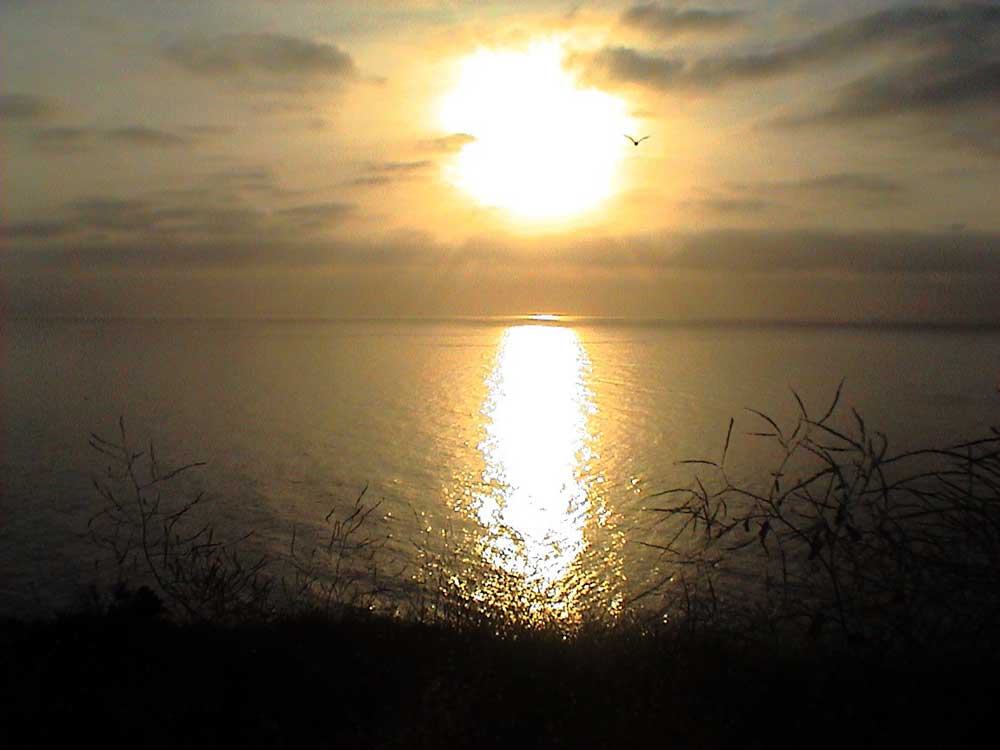
As the sun began to set Lorraine had a heart spoken message to share with us.
Lorraine sat with us and spoke of her concerns.
“Catalina is only a small example of what is happening on Earth right now. The entire island changed when man brought to the island foreign species of plants and animals. We threw the ecosystem out of order. Its not just Catalina Island. It’s Earth. Our polar caps are melting. The temperature of the ocean is changing. We have so much waste that we are destroying the ecosystem of Earth. Haven’t you noticed that the weather is changing? We have days on the mainland when we cannot even take a fresh breath of air.
As the ruling species of this planet we need to remember”
One by one, Cody, Andre, Paul and Tim quietly walked up and sat on the picnic benches beside us.
Lorraine continued,
“We are the Stewards of Earth. We are the stewards of the land and the home that God gave us. It is time for us to reclaim our stewardship of our Earth before its too late.”
We could not deny what Lorraine was telling us.
I left the island wondering, how did we lose our stewardship? Who or what has it now? How do we get it back?
A few years later I heard the message again from a very different perspective early one morning in my dreams.
“We’ve been calling out to get your attention for a very long time. You just couldn’t hear us because you’ve been too busy making a nasty taste. It takes lots of energy to make a nasty taste. You have no energy left to grow.
It is time you remember who you are. It’s time to remember to take back your dominion before it’s too late. Remember the words of your divine creator who came to walk this Earth to tell you. “Love one another as I have loved you.”
The trees on the island taught us about the nasty taste in their own quiet way. Is it possible that the innate intelligence within the trees was somehow speaking through my dreams? With all that’s happening around us across our dear planet Earth, I could not deny their message.
How did we lose our dominion? How can we get it back?

Leave a Reply