It was one of those days when my nerves were frazzled. Every muscle and every limb was hardened and tensed. I couldn’t hold back the frustration that was building in the pit of my gut. The pit of my stomach began to shutter as a rush of tears spilled down my face.
Cody was just a little guy back then. He was kneeling on the floor rolling his little blue truck across an imaginary road. Quietly, stopped the truck and walked over to where I was standing. He stopped in front of me and looked up. I looked down into his almond brown eyes, my body still shuttering and shaking. He grabbed my hands and held them. I remember the feeling of strength and courage of his little hands holding mine. The tenderness of his gesture still warms my heart.
Little Cody looked deeply into my eyes, then said, “Mommy! You need to go to the gym!”
Somehow, even at the tender age of six, he knew what I was feeling. Somehow, he could feel it too.
Cody’s gesture stopped me short and caught my attention.

Cody was watching. He knew what I was feeling. Somehow, he could feel it too.
What was I doing to my precious little son?
At that moment I realized that every time I allowed myself to explode in an emotional outburst, Cody was watching. Cody was sensing my feelings.
If I was hurting inside. I was hurting him.
How did I allow my behavior to get so out of control? Where were my emotional behavior patterns coming from? How could I stop the behavior?
My questions were answered 10 years later in an eyeopening class in November 2014. Dorothy introduced us to a lecture series by an enlightened scientist, Bruce Lipton. As I sat there and listened my mind lit up with a new understanding of where my irrational and hurtful behavior was coming from.
All behaviors are learned, good behaviors and bad behaviors.
From birth until about the age of 7 our subconscious minds record everything that is happening around us. It records every sound we hear, expressions we see in Mom’s face, the sounds and shouts of Dad’s occasional outbursts.
In this way, the child learns how to act and respond, by observing the people around us. Unfortunately most of these responses are negative.
Behaviors are passed down through the generations. They are recorded into the subconscious mind, like programs downloaded into a computer. These behavior programs good or bad, become the behavior programs of our lives.
Dorothy’s statement, “Miasms are lies in the genetic code created by negative word fragmentations of your ancestors.” suddenly made sense.
Then I remembered.
According to Mom I was born in a hurry. As her second child, she knew I was “in a hurry” by the frequency and intensity of those crushing pounding contractions. Dad was pacing back and forth in the small tight space of the elevator.
The contractions were coming faster as the elevator took it’s slow route, stopping at each floor, as we waited for patients and their families to enter and exit.
“Come on! Hurry up Mother!”
“What? I can’t make the elevator go any faster,” said Mom.
The scratchy groaning sound of Mom voice, hoping I would hold on just a few moments longer grew louder and louder. I know that sound. I hear it every time she gets that achy feeling of uncertainty in the pit of her gut.
My subconscious mind was recording every sound heard and unheard, every word thought and spoken, every smell, taste and feeling and every visible and invisible sight in the room. It was recording everything and anything that Mom was experiencing even before I hit the birth canal.
The subconscious mind doesn’t judge whether things are good or bad. It is a multidimensional tape recorder that records everything and anything that is going on around us. Much of what is recorded is negative. It plays those tapes back in our lives as negative behavior.
Given the fact that we had the saddle block that was ridden with whatever drugs that Mom and I had both ingested, I don’t know how awake or alert I was. I have no conscious memory of my birth. Something else does have a memory. It was all recorded in my subconscious mind.
Was I afraid of falling onto that icy cold germ infested elevator floor?
Of course I was! Mom’s emotion of fear and anxiety is a chemical reaction in the body that I was absorbing though her blood.
I can just imagine the scrunched expression on Dad’s face. His coco-brown complexion was tanned from too many hours of hard labor outside on the farm. His forehead was covered with salty hot beads of sweat. Dad’s daily uniform was a pair of indigo blue Levi jeans and a tan Dickie work shirt that he always wore while working out on in the fields. He was nervous. He was scared. He was clenching his teeth and fists tightly, pacing back and forth in that small tiny space of the elevator. He was pacing back and forth in the hallway, looking down at his feet grumbling something I don’t understand.
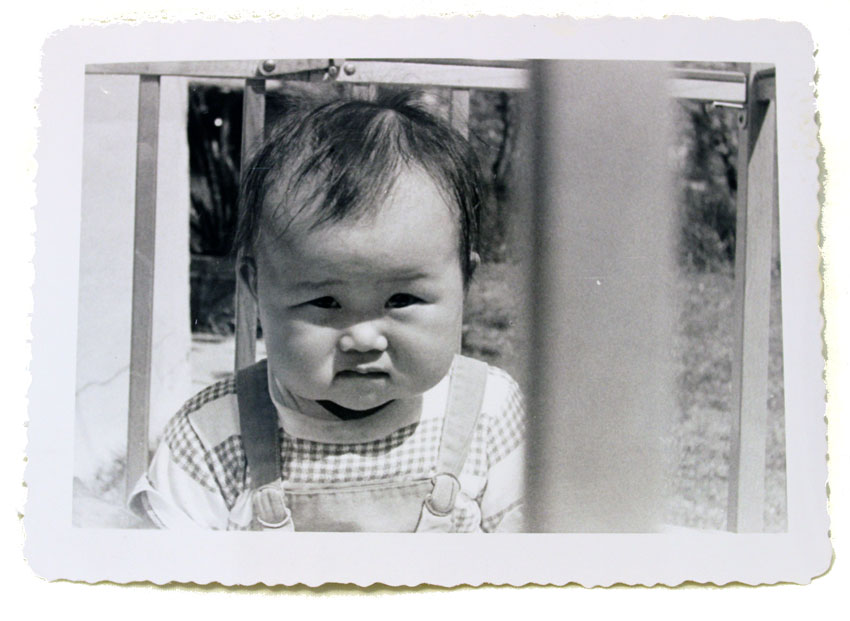
On April 28 1955 at 3 am I landed into the hands of Dr. Oogie. A sweet happy smile lit up Mom’s face when she finally got to hold me in her arms for the very first time. The warm tender feeling of her arms wrapped around me was a feeling that I never wanted to let go of. When she did let go I couldn’t stop crying.
I don’t know how many days Mom and I stayed in the foreign new world of the hospital. The smell of alcohol still brings back a strange sterile feeling as if I was transporting back to those early days in my life. Every sound was very loud to my newborn ears. The sounds of the gurney wheels hitting against the metal structure as it rolled across the floor screeched and moaned and hurt my eardrums. The icy cold breeze in the air as it blew across my face arms and legs prickled the surface of my skin in a way that was piercing to my nerves. Everything made me cry. What else did I know how to do?
Then Mom held me close and I could hear the soft beat of her heart and sense that warm comforting feeling of being held. She started to hum softly a song I would hear many times in the years to come. I stopped crying.
Three days later Mom held me tightly on the long ride home. The tender warm feelings of her arms holding me close, cuddling her newborn baby left my heart at peace.
“You *#!! Get that hunk-a-junk off the road!” Dad yelled loudly and clenched his fist.
I lie there quietly and watched Mom’s face harden into a frown. The corners of her eyes scrunched up and her warm soft hug turned into a tight clenching. Mom squeezed me tightly.
I started to cry.
Mom held me tighter.
I cried louder.
She looked down at me and kissed my forehead.
“I’m sorry,” she whispered softly.
“Can’t you keep her quiet?” Dad yelled again. “I can’t stand that crying!”
That was the beginning of a long training process that Mom and Dad didn’t know they were teaching. Every thought or word spoken, yelled or whispered, every action or moment of stillness is being recorded every moment of our lives. As we learned in class, the subconscious mind records words and actions that later become subconscious programs. These subconscious programs run in the background like a hidden program running in the background of a computer. Many of these background subconscious programs are negative behaviors that we don’t often know we are doing.
Subconsciously, we are “taught” by the people in the environments around us.
From birth to age 7 our minds are in a hypnogogic state that soaks up everything happening around us like a thirsty dry sponge. People, places and things teach us how to behave, how to act, what to do and what to be.
Subconsciously, we pattern our behaviors after the people we are closest to, our mothers and fathers.
We watch their faces and the expressions and the sounds they make and we mimic them. This is how patterns are formed and inherited from one generation to the next, much like a contagious virus.
Errors in our behavior and also in our genes come from come from the people, places and things in our environment.
If we look could deep into the unseen world of energy we could see that everything we think say and do radiates a signal out into the environment. Everyone and everything is sending signals whether we are aware of it or not. We are surrounded by billions upon billions of signals every moment of every day.
It would be impossible to tune into every signal around us. That would cause system overload.
What determines which signals we tune into?
Our perceptions. Our beliefs. Our focus.

Leave a Reply